

New eArocs 400 proves its capabilities in winter testing at minus 20 degrees
Download

New eArocs 400 proves its capabilities in winter testing at minus 20 degrees
Tests deliver essential data for optimizing the Mercedes-Benz eArocs 400 ahead of series production Michael Kimmich, Head of Development eArocs 400: “The winter tests in Finland subjected the eArocs 400 to demanding trials under dry, extremely cold conditions - trials it handled with confidence. With stable driving characteristics and a range and charging performance well within the expected parameters, it clearly…
- Tests deliver essential data for optimizing the Mercedes-Benz eArocs 400 ahead of series production
- Michael Kimmich, Head of Development eArocs 400: “The winter tests in Finland subjected the eArocs 400 to demanding trials under dry, extremely cold conditions - trials it handled with confidence. With stable driving characteristics and a range and charging performance well within the expected parameters, it clearly demonstrated its capability.”
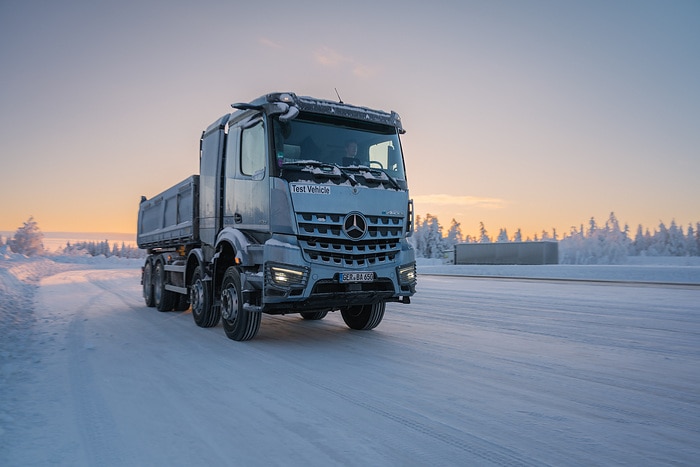
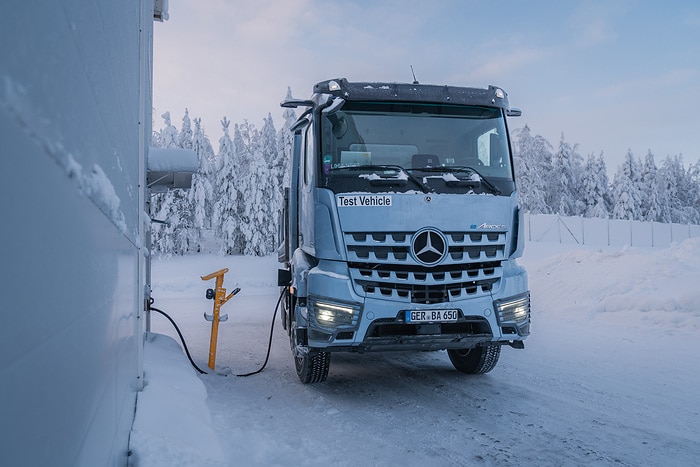
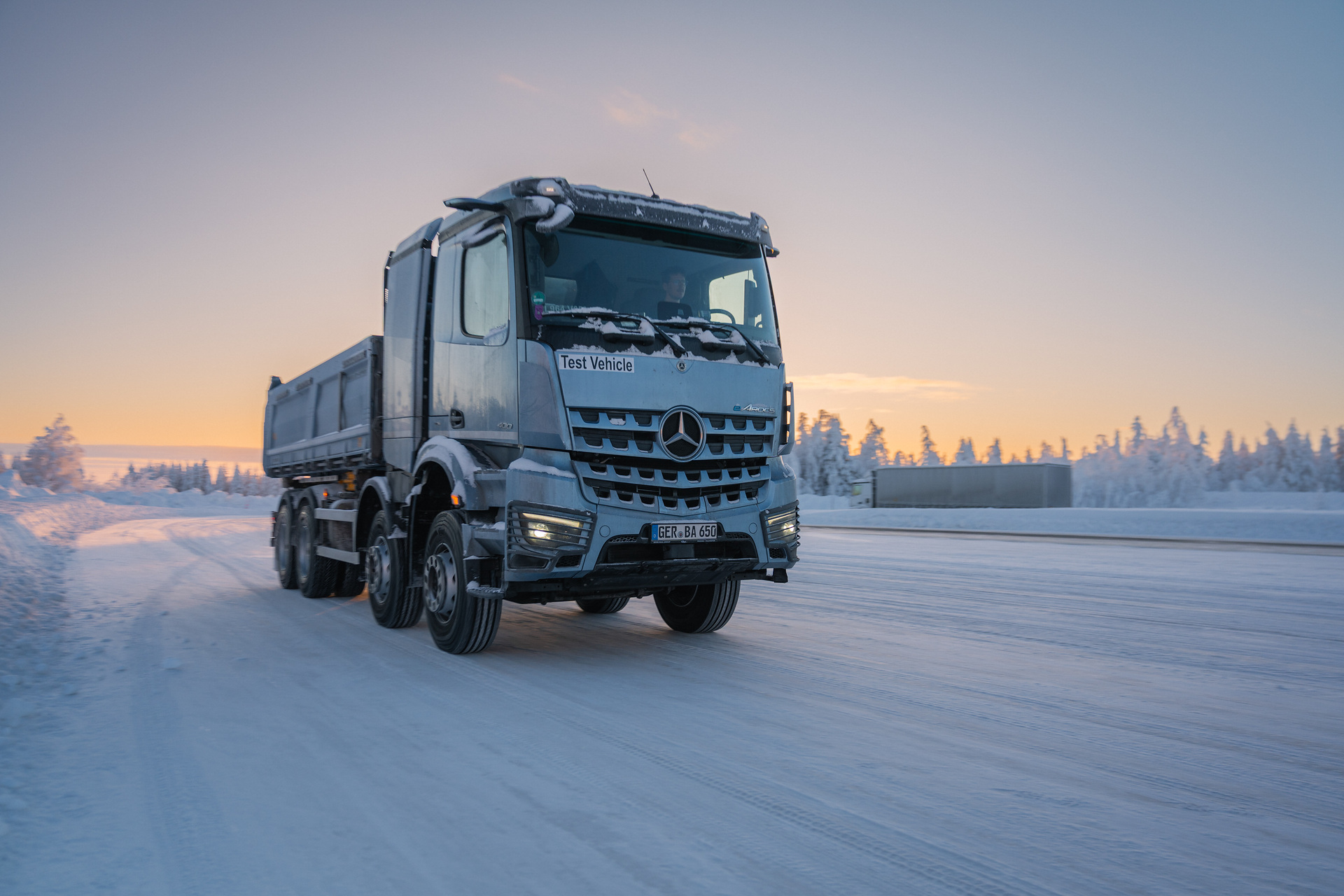
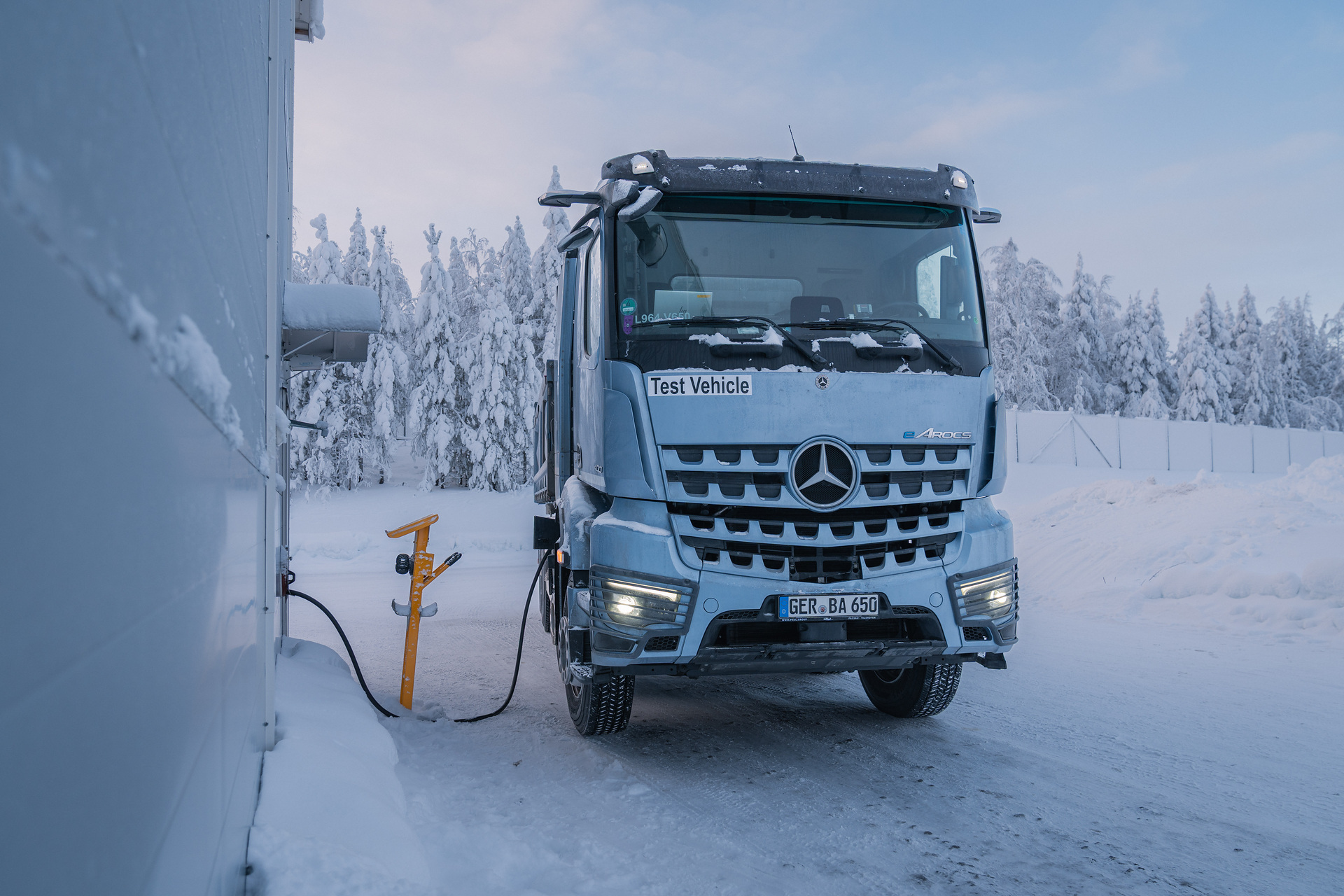
Leinfelden-Echterdingen/Finland – The new battery electric Mercedes-Benz eArocs 400 designed for urban construction transport has successfully completed intensive winter testing under extreme conditions. At temperatures reaching –20 °C, the locally CO₂e free and low noise electric truck underwent targeted trials on snow and ice near the Arctic Circle earlier this year to ensure reliable operation even in severe winter environments.
The tests focused on traction and driving stability on snow and ice covered roads, cold start performance, battery and charging behavior at extreme subzero temperatures, as well as the efficiency of the electric powertrain and recuperation performance during winter operation.
Michael Kimmich, Head of Development eArocs 400, commented: “The winter tests in Finland subjected the eArocs 400 to demanding trials under dry, extremely cold conditions — trials it handled with confidence. With stable driving characteristics and a range and charging profile within the expected parameters, it clearly demonstrated its capability.”
Testing under extreme winter conditions provided Mercedes-Benz Trucks engineers with valuable insights for further refining the eArocs 400 ahead of its series production launch. It also underscores the company’s ambition to offer electric commercial vehicles capable of meeting demanding year round operational requirements.
The eArocs 400 will go on sale at the beginning of April this year. The base vehicle will be produced at the Mercedes-Benz plant in Wörth am Rhein starting in the third quarter of 2026. Final integration of the electric powertrain will then be carried out by the Paul Group based in Vilshofen an der Donau (Germany).
About the eArocs 400
The locally CO₂e-free and low-noise electric truck celebrated its world premiere in 2025 at bauma, the world's leading trade fair for construction vehicles, building machines, construction material machines, mining machines and construction equipment in Munich. There, it demonstrated that the construction industry can also benefit from battery-electric vehicle solutions. The vehicle will initially be available as a 37-ton and 44-ton variant in the 8x4/4 axle configuration and in four different wheelbases. It can be built as a concrete mixer or construction tipper, thus covers essential applications for street-oriented construction transport. Thanks to its local CO₂e neutrality during driving, the eArocs 400 can enter low- and zero-emission zones in inner-city areas and is also suitable for noise-sensitive environments such as residential areas, the environment of hospitals, schools and kindergartens as well as for night-time construction sites due to its low noise emissions.
For the new eArocs 400, Mercedes-Benz Trucks is adopting essential components from the eActros portfolio. In addition to the front box and the power take-off (PTO), this also includes batteries based on lithium iron phosphate cell technology (LFP). These batteries feature in particular a long durability and a particularly high usable battery capacity.
Due to its significantly higher efficiency and additional potential for energy savings – arising, among other factors, from recuperation and electrically powered auxiliaries – the eArocs 400 is at least 50 percent more energy efficient than a comparable diesel truck. It has an on-board electrical system voltage of 800 volts and two battery packs with an installed battery capacity of a total of 414 kWh[1] located in the battery tower directly behind the driver’s cab. The range as a concrete mixer is up to 200 kilometers[2]. With the construction tipper variant, the range increases to up to 240 kilometers[3]. This allows many use cases to cover a full working day without the need for intermediate charging. The eArocs 400 can be charged with up to 400 kW via the standard CCS2 charging socket mounted on both sides of the vehicle. The two battery packs need approximately 46 minutes to charge from 10 to 80 percent[4].
The eArocs 400 is fitted with a powerful central drivetrain with an integrated 3-speed transmission and a continuous power of 380 kW and a peak performance of 450 kW. In combination with this technical powertrain solution, the tried-and-tested hypoid and planetary axles of the Arocs can be used to still offer the ground clearance and off-road capability required for construction site deployment.
Thanks to the Multimedia Cockpit Interactive 2 installed in the eArocs 400, improved ergonomic switch panel and voice control, operation is possible even in uneven terrain. Modern safety assistance systems[5] such as Active Brake Assist 6 Plus, Active Sideguard Assist 2, and Front Guard Assist support the drivers of the eArocs 400 in early hazard detection, timely braking, and maintaining an overview in traffic and on the construction site.
Both inside and out, the eArocs 400 is tailored to the day-to-day requirements of street-oriented construction transport. For example, the tandem drive axles ensure sufficient traction both on and off the road. Proven components such as the robust vehicle frame and the steel suspension at the front and rear provide the level of durability required for day to day construction site operations. The M cab with easy-care interior, extra stowage space and optional bunk is fully galvanized and also guarantees maximum body length with maximum maneuverability.
Sustainability at Mercedes-Benz Trucks
Sustainability is an integral part of the Mercedes-Benz Trucks strategy. As part of Daimler Truck AG, Mercedes-Benz Trucks is committed to contributing to the decarbonization of road freight transport and driving the transformation of the transport industry. Through battery-electric and hydrogen-based drive technologies, digital services, and climate-friendly, resource-efficient production and supply processes, Mercedes-Benz Trucks is helping to pave the way toward locally CO₂e-free transport across the entire value chain. In doing so, Mercedes-Benz Trucks makes a significant contribution to Daimler Truck AG’s overall sustainability strategy.
(1) Nominal capacity of a new battery, based on internally defined boundary conditions. This may vary depending on the application and ambient conditions.
(2) The range was determined under specific boundary conditions based on internal simulations with an 8x4 concrete mixer with 32 t permissible gross vehicle weight in an 8h concrete mixer operation at an ambient temperature of 20°C and may deviate from the values determined in accordance with Regulation (EU) 2017/2400 due to numerous factors such as topography, weather conditions, speed, preconditioning, auxiliary consumers, individual vehicle configuration and driving style.
(3) The range was determined under specific boundary conditions based on internal simulations with an 8x4 construction tipper with 32t permissible gross vehicle weight in an 8h vehicle operation at an ambient temperature of 20°C and may deviate from the values determined in accordance with Regulation (EU) 2017/2400 due to numerous factors such as topography, weather conditions, speed, preconditioning, auxiliary consumers, individual vehicle configuration and driving style.
(4) The charging time is based on the conditions defined for heavy duty trucks in ISO/SAE 12906 – with 400 kW charging power at a standard DC fast-charging station with 500 A.
[5] With all these assistance systems, Mercedes-Benz Trucks aims to provide the driver with the best possible support when driving the vehicle within the system limits. However, the driver remains fully responsible for driving the vehicle safely at all times, as is also required by law.
Download
New eArocs 400 proves its capabilities in winter testing at minus 20 degrees
Tests deliver essential data for optimizing the Mercedes-Benz eArocs 400 ahead of series production Michael Kimmich, Head of Development eArocs 400: “The winter tests in Finland subjected the eArocs 400 to demanding trials under dry, extremely cold conditions - trials it handled with confidence. With stable driving characteristics and a range and charging performance well within the expected parameters, it clearly…
Article assets
Download
New eArocs 400 proves its capabilities in winter testing at minus 20 degrees

Download
New eArocs 400 proves its capabilities in winter testing at minus 20 degrees
Download

New eArocs 400 proves its capabilities in winter testing at minus 20 degrees
Download

New eArocs 400 proves its capabilities in winter testing at minus 20 degrees
Download

New eArocs 400 proves its capabilities in winter testing at minus 20 degrees
Download

New eArocs 400 proves its capabilities in winter testing at minus 20 degrees
Download
New eArocs 400 proves its capabilities in winter testing at minus 20 degrees
Download

New eArocs 400 proves its capabilities in winter testing at minus 20 degrees
New eArocs 400 proves its capabilities in winter testing at minus 20 degrees
New eArocs 400 proves its capabilities in winter testing at minus 20 degrees

New eArocs 400 proves its capabilities in winter testing at minus 20 degrees

New eArocs 400 proves its capabilities in winter testing at minus 20 degrees

New eArocs 400 proves its capabilities in winter testing at minus 20 degrees

New eArocs 400 proves its capabilities in winter testing at minus 20 degrees
New eArocs 400 proves its capabilities in winter testing at minus 20 degrees
New eArocs 400 proves its capabilities in winter testing at minus 20 degrees

Ulrike Burkhart
Truck Product & Defence
ulrike.burkhart@daimlertruck.com
+49 160 861 3757

Katrin Fischer
Truck Product
katrin.fischer@daimlertruck.com
+49 176 30966698