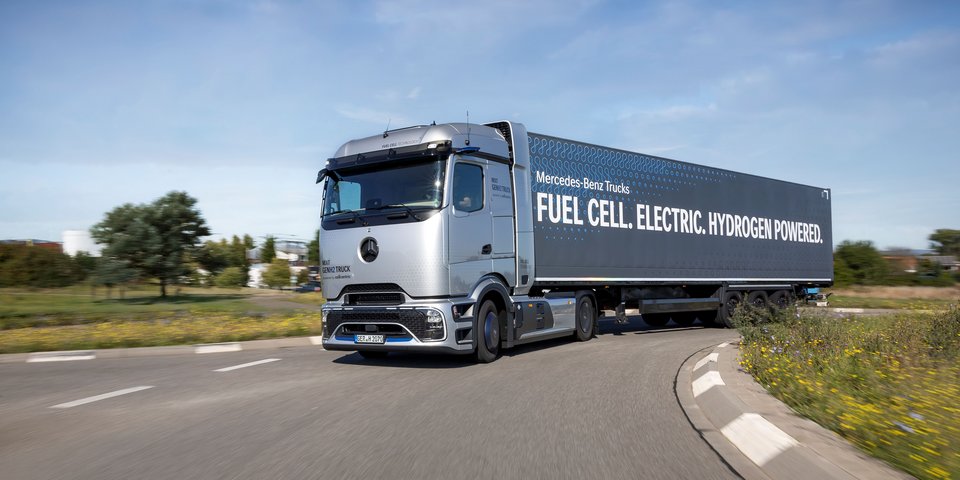
At Daimler Truck, we are committed to the Paris Climate Protection Agreement.
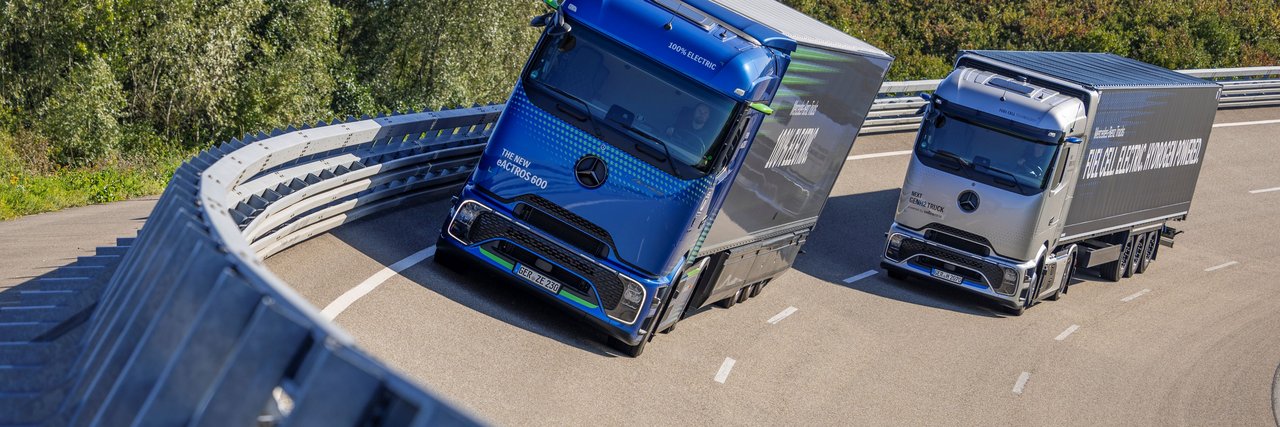
We focus on these locally CO₂e-free technologies
Our ambition is to contribute to locally CO₂e-free road transport in the long term.
To get there, we are pursuing a dual track strategy of battery electric and fuel cell. We’re convinced both have a place in the market. We expect both technologies to play a role in future transport applications. The rule of thumb is this: The battery is better suited for lesser loads and shorter distances, and the fuel cell for larger loads and longer distances. In addition, we will need both technologies due to the requisite infrastructures. Different energy infrastructures may be required to support the widespread adoption of zero-tailpipe-emission commercial vehicles.
We want to avoid, wherever possible, bridging technologies that enable certain progress but not allow us to reach our ambition to contribute to locally CO₂e-free road transport in the long term.
We cannot and should not afford, either financially or in terms of time, to build additional systems and infrastructures in parallel that may not contribute to our long-term decarbonization pathway to the same extent. Politics, business and society with all stakeholders must join forces now.
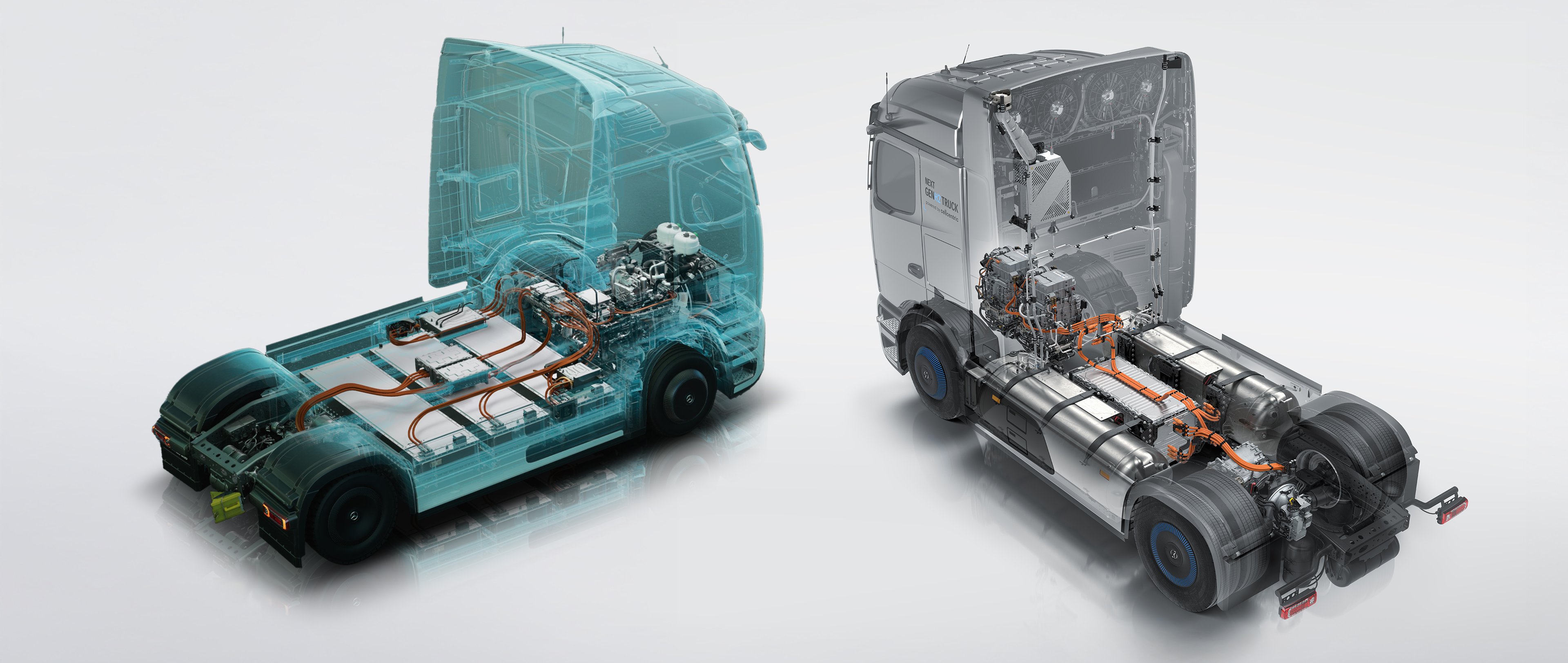
X-ray view of Mercedes-Benz eAcros 600 and NextGenH2 Truck
Daimler Truck
-
Battery electric drive
Daimler Truck is consistently driving forward the electrification of road freight transport and already offers battery-electric solutions for a broad range of applications today, from heavy-duty distribution haulage and long-haul transport to construction and municipal operations. These vehicles are already in daily use by customers.
For both battery-electric and hydrogen-based drivetrains, we use shared technological building blocks and components. This enables us to realize economies of scale and deploy development resources efficiently.
Today, Daimler Truck offers nine battery-electric series-production vehicles worldwide and continues to advance both battery and hydrogen technologies.
Further information on our ePortfolio can be found here.
-
Hydrogen based drive
Daimler has been working on drive technologies based on hydrogen for more than 30 years. To date the company’s fuel cell vehicles (cars and trucks) have traveled many millions of kilometers, demonstrating the technical capabilities and maturity of the technology. In order to get the hydrogen drive into series production as soon as possible, Daimler Truck is making large investments.
One of these investments resulted in the establishing cellcentric, a joint venture with Volvo Group, which will put one of Europe’s largest production facilities for fuel-cells in operation. Since 2021, first prototypes of the Mercedes-Benz GenH2 Truck are undergoing rigorous testing and have demonstrated their capabilities at the Brenner Pass, one of Europe's busiest and most challenging transit routes and in a #HydrogenRecordRun exceeding the target range of 1000+ km on one tank filing of liquid hydrogen.
The first fuel cell trucks were successfully tested in customer hands. With the Mercedes-Benz NextGenH2 Truck, the second generation of a fuel cell truck was introduced in early 2026. As part of a limited small-series production, 100 vehicles are set to be deployed in customer operations from the end of 2026 onwards. Series production of fuel cell trucks is targeted for the early 2030s.
Exclusively for pre-development purposes, Daimler Truck is also investigating the hydrogen combustion engine. Initial results show that the hydrogen combustion engine could be a sensible, complementary solution for decarbonizing Daimler Truck’s powertrain portfolio.
Daimler Buses has been producing the electrically powered Mercedes‑Benz eCitaro fuel cell city bus since 2023. The citybus has a hydrogen‑based fuel cell as a range extender. The vehicle is already in daily customer operation in numerous cities. In addition, the first coach equipped with a fuel‑cell drivetrain has been undergoing test drives since September 2025: TThe Setra technology carrier 'H₂ Coach' supports the development and testing of fuel-cell technology for longer-distance coach applications. Daimler Buses plans to have battery-electric coaches in its portfolio by the end of the decade, with fuel cell coaches to follow in the next step.
-
Gaseous fuel engines
Natural gas is a fossil fuel - and therefore it is at most a transitional technology on our way to locally CO2e-free transport.
Truly locally CO2e-free transport only works with battery electric or hydrogen-based drive. That's why Daimler Truck is consistently focusing on battery electric and hydrogen-powered commercial vehicles that can drive locally CO2e-free.
-
Bio fuels
All of our important truck engines of the latest generation can be fueled with alternative, so-called bio fuels according to the EU standard prEN 15940. These include the subgroups Hydrotreated Vegetable Oil (HVO), Biomass To Liquid (BTL), Gas To Liquid (GTL), Coal To Liquid (CTL). These consist of a variety of resources that are being converted to fuels through chemical processes.
Since the characteristics of these fuels according to norm prEN 15940 mean that they are absolutely comparable to conventionally produced petroleum-based diesel fuel, no modifications to the engines or their peripherals are necessary.
-
Catenary trucks
Daimler Truck is focused on developing solutions that have great potential for worldwide implementation. Due to the high infrastructure costs involved, and also considering of the rapid development of battery and fuel cell technology, the company we do not see potential in catenary trucks at present.
Daimler Truck is not against catenary trucks, but for realistic and timely solutions. We are convinced that with the battery electric truck we have a flexible and already available concept for the respective field of application - without expensive, time-consuming and lengthy planning measures. The eActros is already in series production.
Daimler Buses
-
Electric drive
In public transport, there is no single customer scenario for electric buses – the use cases vary, for example depending on the range and topography. Thus, we want to give our customers choices and meet their needs best.
Our all-battery electric Mercedes-Benz eCitaro city bus has been in series production since 2018. Since 2023, the vehicle has also been available with a hydrogen-based fuel cell as a range extender.
Our electric bus also offers different ways of charging technology, meeting individual requirements of the transport companies. Innovative thermal management ensures efficient energy consumption and forms the basis for a practical range. More information on our product portfolio can be found here.
Our first battery-electric intercity bus, the Mercedes-Benz eIntouro, is planned to follow from 2026.
-
Hydrogen-based fuel cell
The battery-electric Mercedes-Benz eCitaro fuel cell city bus with a hydrogen-based fuel cell as range extender can operate exclusively with hydrogen using a special operating mode. The vehicle can thus be used completely independently of any electric charging infrastructure. When the eCitaro fuel cell is operated exclusively with hydrogen, the fuel cell takes over all battery charging processes. This enables a new operating mode that can be flexibly selected by the customer. Stationary charging of the battery via the mains supply is no longer necessary. The battery and the fuel cell remain the main energy source for the drive. Depending on the battery generation, ranges of up to 480 kilometers[1] can be achieved. This means that the eCitaro fuel cell can meet the requirements of transport operators who prefer to use green hydrogen instead of mains electricity as an energy source.
[1] The range was determined internally under specific conditions, including equipment with maximum battery capacity and H2 capacity, battery in as-delivered condition, in typical city bus operation and in a moderate weather scenario, and may, for example, deviate from the values determined in accordance with Regulation (EU) 2017/2400. The actual range depends on the individual use of the vehicle, the vehicle configuration and other external factors. The actual range may therefore be below or above the specified value.
-
Hybrid
The Mercedes-Benz Citaro hybrid is available in a variety of model variants of the best-selling city bus Citaro. Thus, fuel consumption of the already very efficient conventional Citaro is further reduced, and even more so thanks to electrohydraulic steering, depending on the application and vehicle model. Lower fuel consumption quickly pays off for public transport companies. Society and the environment benefit from lower emissions.