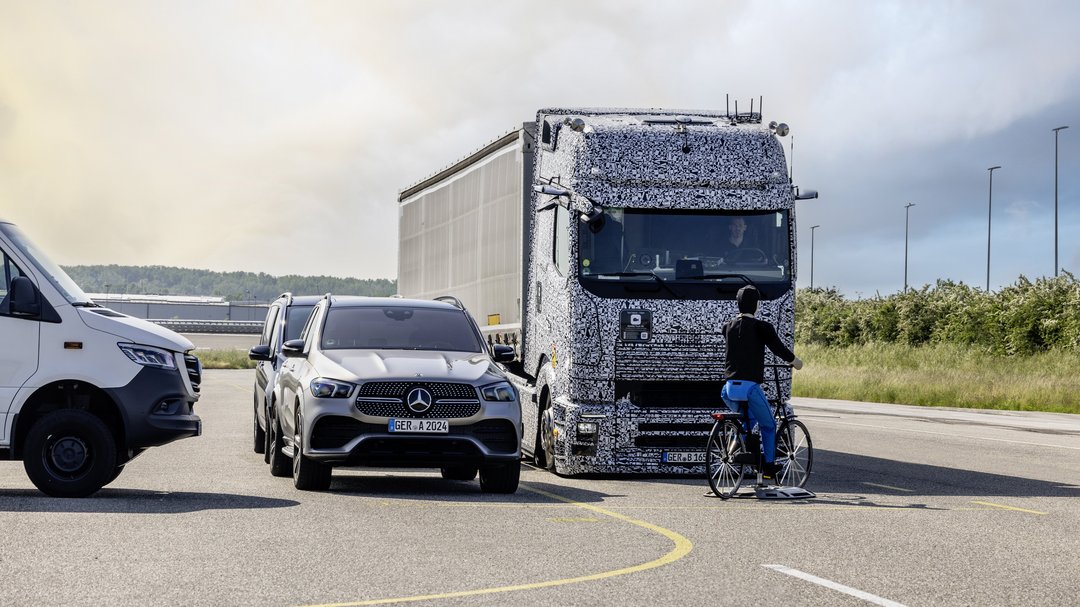
Preventing accidents altogether or at least mitigating their consequences has always been a top priority for Daimler Truck across all model series. That is why new, more effective safety and assistance systems are constantly being developed for the vehicles and existing systems optimized.
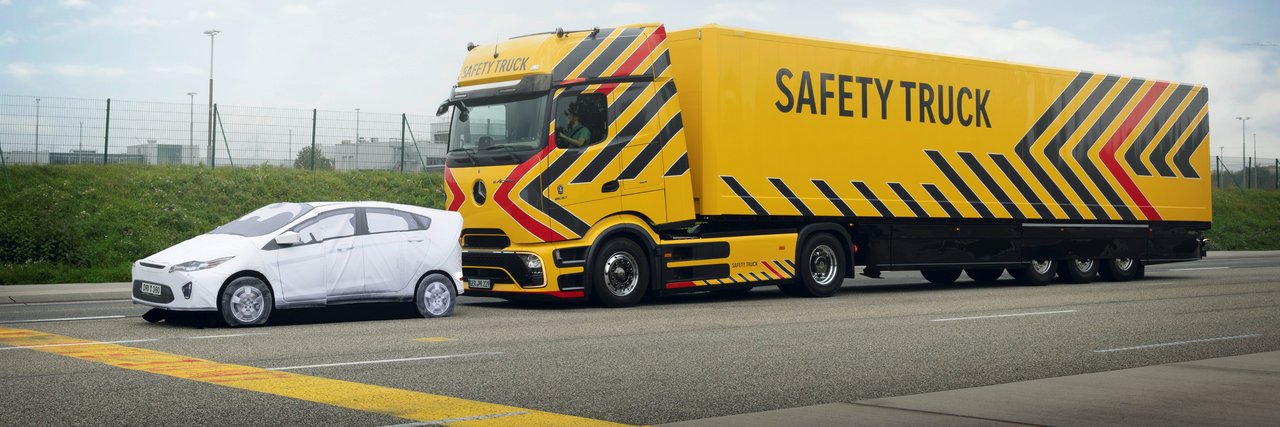
Active and Passive Safety - Truck
Almost all of the safety and assistance systems that are now mandatory for trucks were first used in a Mercedes-Benz truck. The systems not only comply with the General Safety Regulation (GSR) standards that have been in force since July 2024, but in some cases exceed them in scope. In the case of the further developed Active Brake Assist 6 Plus and the also further developed Attention Assist 2 – both systems will be available from February 2026 – both systems already pre-fulfill some of the regulations for the coming years.
With all assistance systems, Mercedes-Benz Trucks aims to provide the drivers with the best possible support and relief during their journey within the system limits. The boundaries of physics cannot be pushed with these systems. As stipulated by law, the driver remains fully responsible for the safe operation of the vehicle at all times.
All road users are affected
Safety assistance systems can help to ensure that moments of inattention due to fatigue, stress, or distraction, for example, have as few serious consequences as possible for everyone involved. In addition to vehicle occupants, this benefits other road users in particular, such as those traveling by car, bicycle, or on foot.
Why trucks from Mercedes-Benz could save lives
-
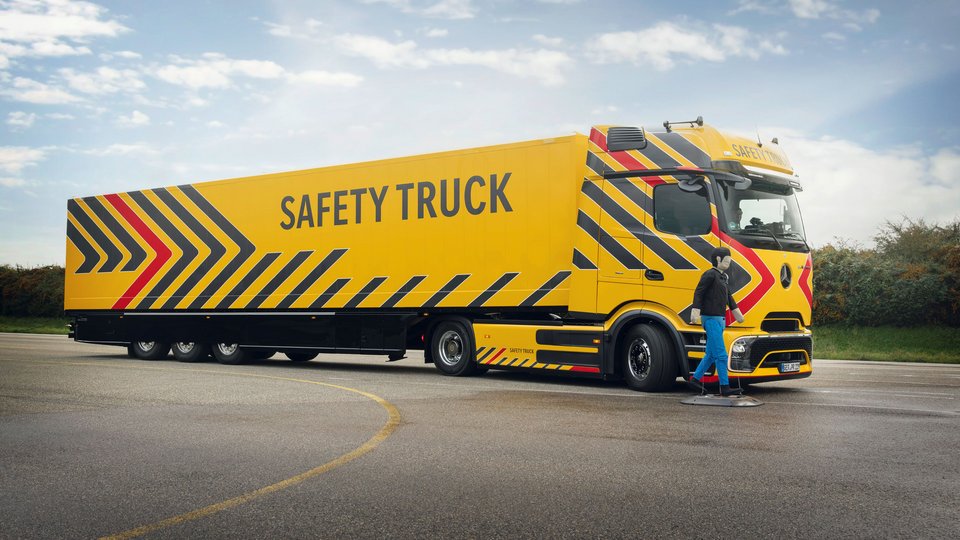
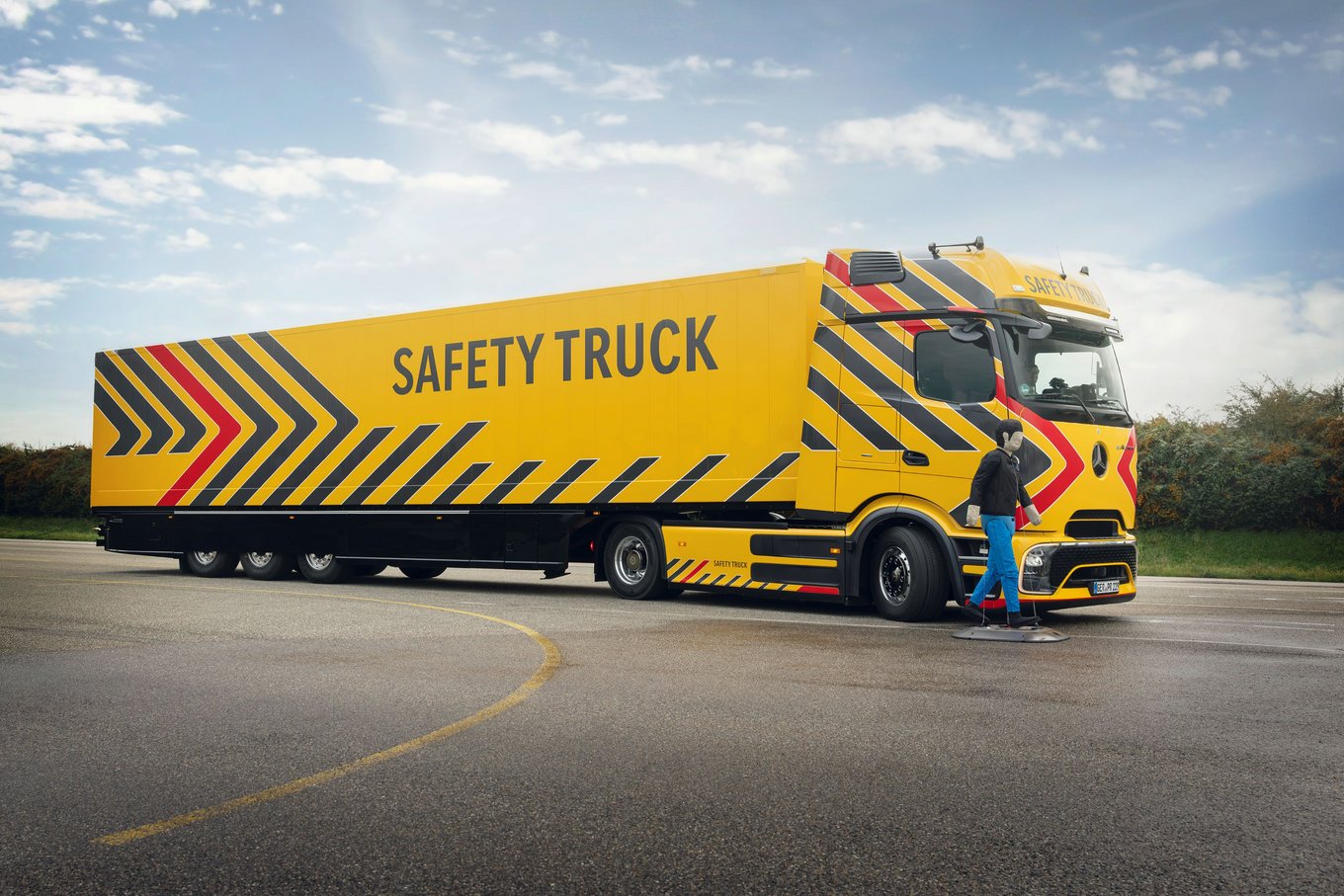
Active Sideguard Assist 2: When turning, the system can initiate automated braking on the passenger side in an emergency until the vehicle comes to a standstill. -

The MirrorCam can help make situations such as overtaking, maneuvering, driving in poor visibility and darkness even safer and less stressful. -
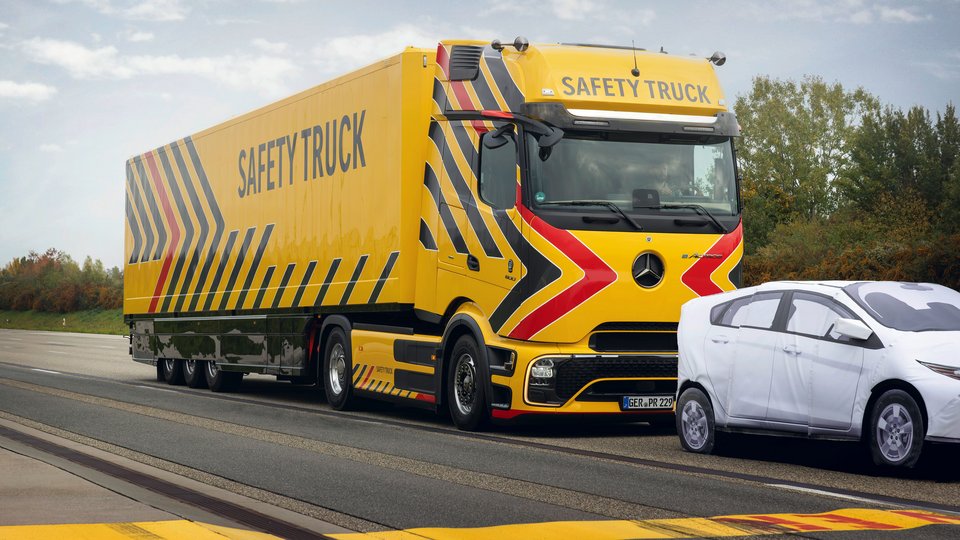
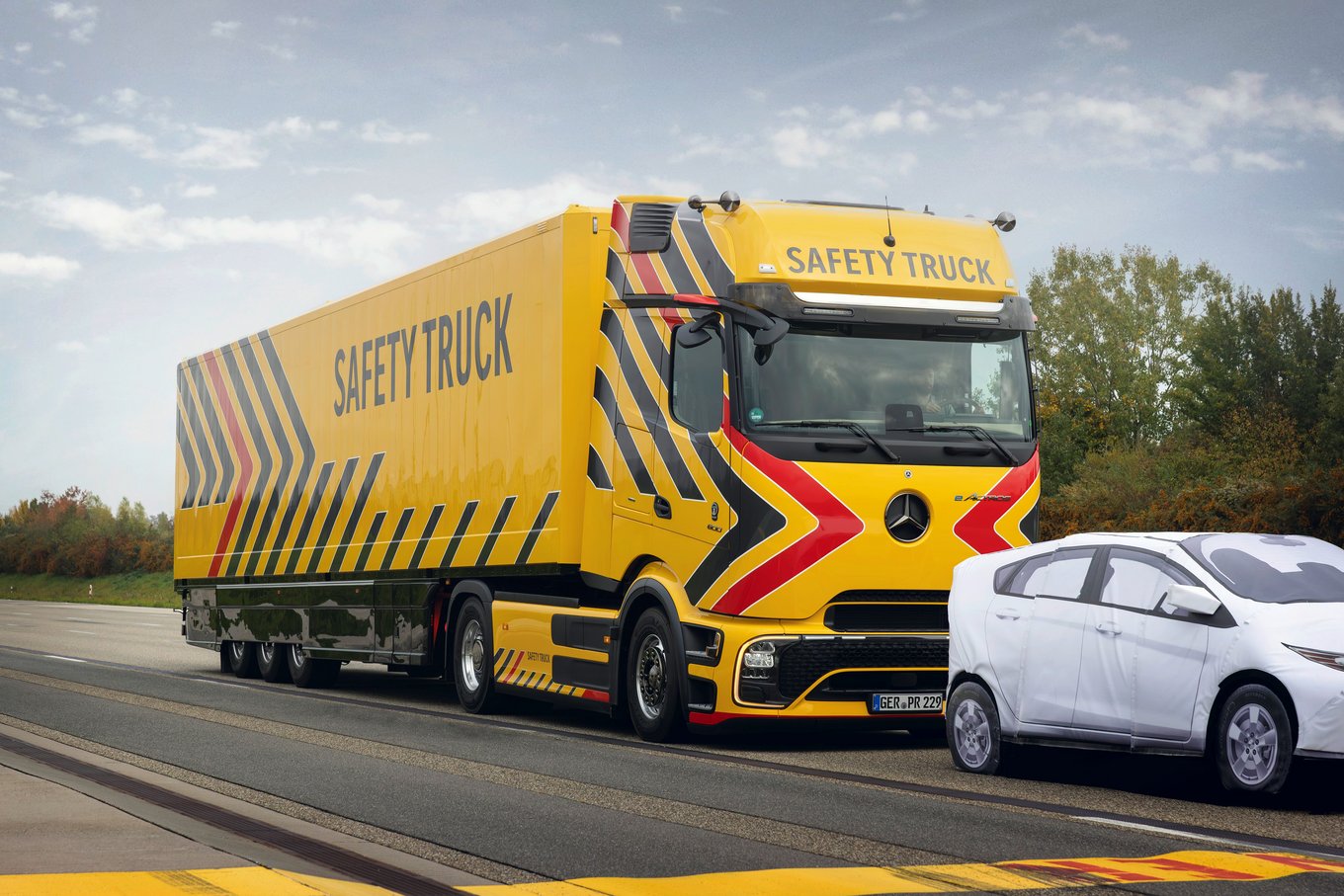
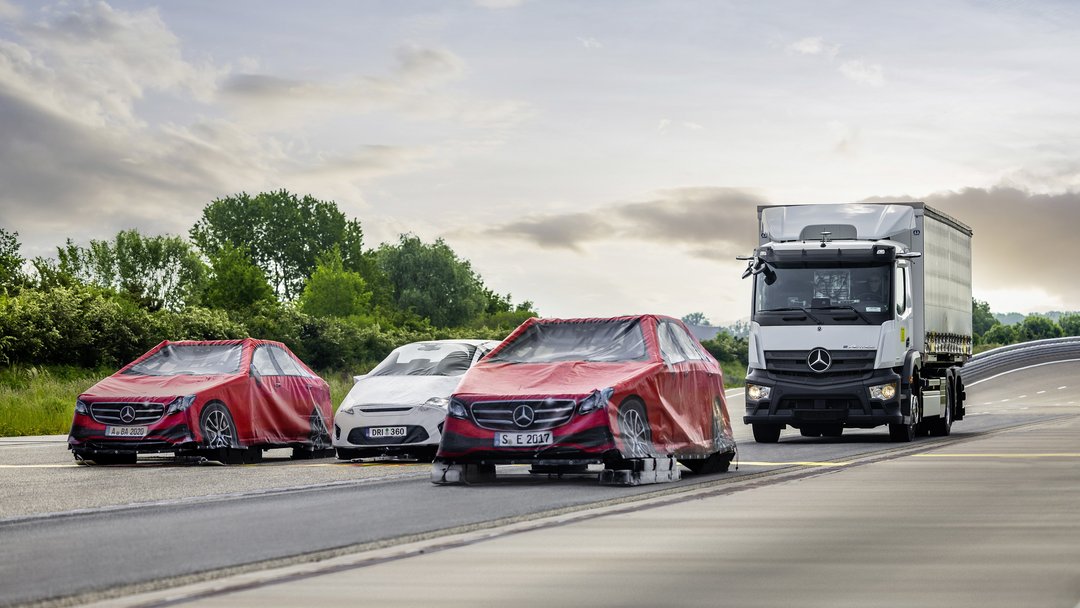
Daimler Truck's latest emergency brake assist system (Active Brake Assist 6 Plus) can react to pedestrians crossing, approaching, or walking in the lane, as well as cyclists, at speeds of up to 60 km/h with automated emergency braking until the vehicle comes to a complete stop. -
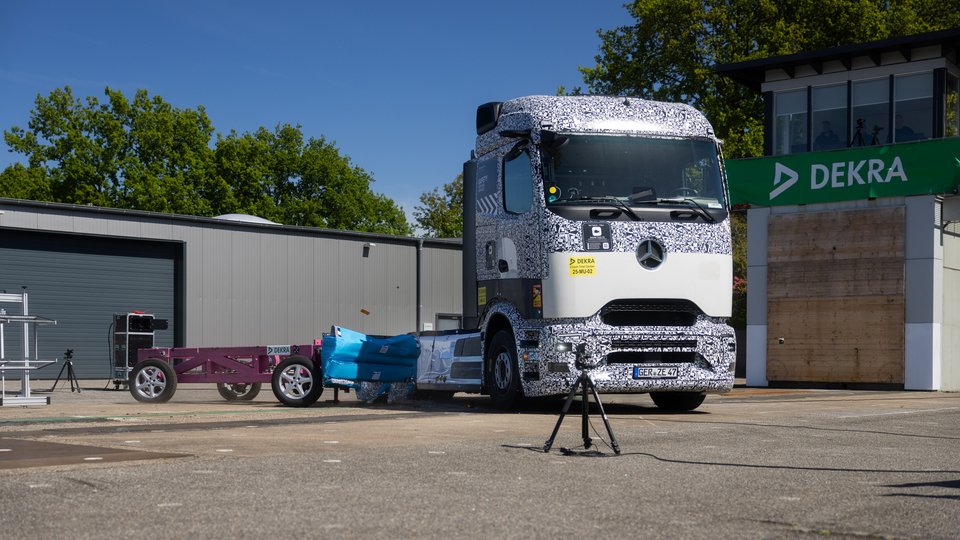
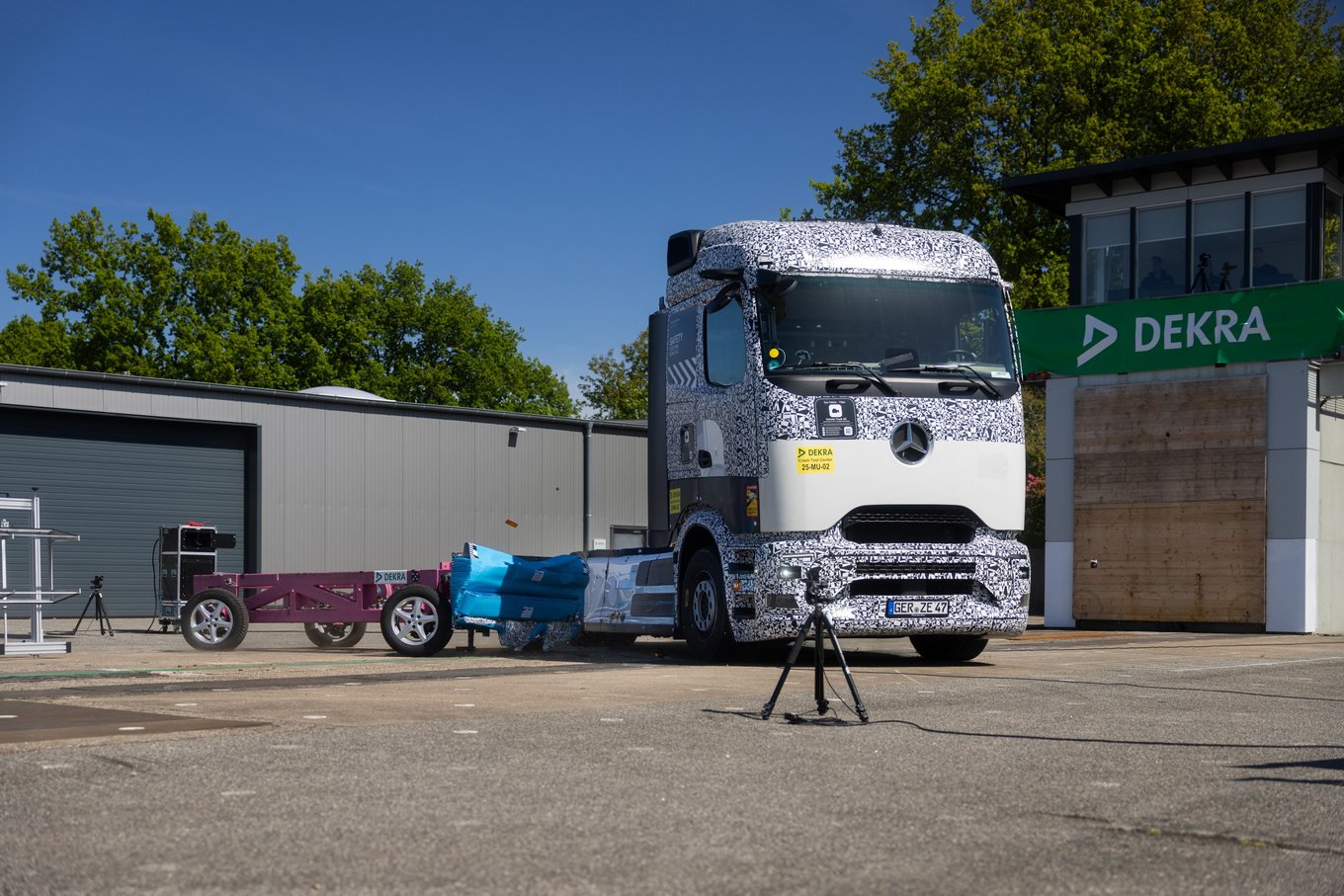
High passive safety of the Mercedes-Benz eActros 600 is confirmed in crash tests.



-
New electronics platform
When it comes to active safety systems, equipping vehicles with cameras and sensors is crucial to their effectiveness. In this context, Mercedes-Benz Trucks has introduced a new electronics platform which uses sensor fusion to combine radar and camera data, enabling an even wider detection range to the front and sides. The electronic platform offers 20 times higher data processing power, and the six sensors installed – four short-range radars on the front and rear, both on the right and left, a long-range radar in the front center, and a multifunction camera in the windshield – can cover an angle of 270 degrees around the vehicle. As a result, the built-in safety assistance systems can play to their strengths even better.
-
Active Brake Assist 6 Plus with multi-lane monitoring
One example of the efficiency of the 270-degree fusion technology and the partial overfulfillment of the General Safety Regulation is the Active Brake Assist (ABA), in its sixth generation. Daimler Truck's latest emergency brake assistant can now react to pedestrians crossing, approaching, or walking in the lane, as well as cyclists, with automated emergency braking to a standstill at speeds of up to 60 km/h. The GSR requires the extended response to pedestrians and cyclists for new trucks and buses only from July 1, 2026. As before, the system can react to vehicles in front at speeds of up to 80 km/h with emergency braking to a standstill. Another added value of ABA 6 is multi-lane monitoring at a distance of up to 250 meters for even better hazard detection.
Active Brake Assist 6 already pre-complies with AEBS (Advanced Emergency Braking System) legislation, which will come into force in September 2028. Thanks to the 270-degree fusion technology, the system is able to react even faster to critical situations. This means that accidents can be avoided more effectively, both for vehicles traveling at up to 90 km/h and for pedestrians and cyclists traveling at up to 60 km/h.
-
Lane Keeping Assist: The lane in the camera view
To ensure that a brief moment of inattention has as few serious consequences as possible, Lane Keeping Assist is a proven system – it can alert the driver to an imminent departure from their marked lane by means of an acoustic and visual signal with a warning message on the display. To do this, a digital camera constantly monitors the road ahead of the truck and can detect dangerous deviations from the lane on marked roads.
-
New Attention Assist 2 calculates viewing angle and fatigue level
Attention Assist 2 is available since February 2026. The system can help prevent accidents by issuing visual and audible warnings if the driver is inattentive or overtired. Using an integrated infrared camera for visual recognition of head and pupil position, it detects not only the driver's fatigue level based on signs such as increased blinking, yawning, or drooping eyelids, but also the driver's attention level based on the calculated viewing angle. This is a closed system: all data remains exclusively in the vehicle and is deleted by the system after 15 minutes.
-
Active Sideguard Assist 2 with extended functionality on the driver's side
The extent to which equipping vehicles with six sensors and the associated increased detection range can improve road safety is demonstrated by the second-generation Active Sideguard Assist (ASGA). ASGA 2 monitors traffic on both the driver's and passenger's sides and, with its two-stage warning system, can alert drivers to potential hazards so that critical traffic situations can be defused by timely intervention. ASGA 2 can provide information and warnings on both sides across the entire speed range and also covers the legally required area on the passenger side. More specifically, this is 30 meters behind and 7 meters in front of the vehicle up to a speed of 30 km/h. The system can also initiate automated braking up to a speed of 20 km/h when turning right until the vehicle comes to a standstill if the driver has not responded to an acoustic and visual warning. With this function, the system exceeds the requirements of the General Safety Regulation, which stipulates that the turning assistant must issue a warning if necessary. In addition, ASGA 2 features an intelligent lane change warning concept that depends on the vehicle's position in the lane.
-
Front Guard Assist monitors the traffic area immediately in front of the vehicle
The Front Guard Assist can be a helpful feature for avoiding accidents with pedestrians or cyclists who may be directly in front of the truck when starting off. The assistance system monitors the traffic area in front of the vehicle and supports drivers when the vehicle is stationary, when starting off, and at intersections. If the system detects stationary or moving objects in front of the vehicle, it supports drivers in driving situations up to 15 km/h by issuing hazard warnings via the two-stage warning system. The 270-degree fusion technology covers the blind spot in front of the vehicle from 0.8 meters to approximately four meters across the entire width of the vehicle.
-
Traffic Sign Assist recognizes traffic signs in real time
Daimler Truck goes beyond the General Safety Regulation with another assistance system: Traffic Sign Assist. While EU regulations only require the display of the applicable speed limit, the system also recognizes overtaking restrictions and their lifting, as well as other warning signs, and always displays the last two identified signs on the cockpit. By intelligently linking camera and map data, Traffic Sign Assist also supports the driver by permanently displaying the last recognized speed limit relevant to trucks, which in turn makes it easier to comply with the permitted speed. Traffic Sign Assist works despite the different signage in Europe.
-
Reducing the risk of skidding: Stability Control Assist and Rollover Control Assist
Two active safety systems designed to reduce the risk of skidding in tractor units and semi-trailers, particularly when cornering or performing evasive maneuvers, are Stability Control Assist and Trailer Stability Control Assist. In critical driving situations, when the vehicle tends to understeer or oversteer when cornering, the braking forces on each individual wheel are specifically controlled. In addition, engine power is reduced and the possible “buckling” of the semi-trailer is prevented by simultaneous, measured braking of the trailer, even if it is still equipped with a conventional pneumatic braking system.
The active stability control system also detects any tendency for semi-trailers to tip over at an early stage. If the trailer reaches the tipping point unnoticed by the driver in long curves – such as on highway exits – or during fast lane changes, the speed of the semi-trailer truck is automatically reduced until driving stability is fully restored. Within the limits of physical possibilities and system limitations, this significantly reduces the risk of the semi-trailer tipping over.
The roll control assistant also serves to protect the driver and vehicle. The system automatically adjusts the damping hardness to the respective driving situation and road conditions. Sensors detect vertical movements on the front and rear axles, brake pressure, load status, accelerator pedal movements, and speed. These values are recorded and evaluated by the central control electronics and transmitted as control signals to the shock absorbers, which are equipped with an electrically controllable valve.
-
Active Drive Assist: Relaxed semi-automated driving
The third generation of Active Drive Assist (ADA 3) enables semi-automated driving (Level 2). ADA 3 provides better support to the driver in terms of longitudinal and lateral control of the truck. The emergency steering function is a particularly new feature: if Active Sideguard Assist 2 (ASGA 2) detects a risk of collision when changing lanes, ADA 3 can actively countersteer to prevent the vehicle from leaving the lane and guide it safely back into its own lane.
Like the previous generation, ADA 3 can also automatically maintain distance, accelerate, and steer, provided that the necessary system conditions are met, such as a sufficient curve radius or clearly visible lane markings. If the driver is in danger of getting too close to a vehicle in front, ADA 3 can automatically brake the truck to maintain the set distance to the vehicle in front. Once there is sufficient distance again, the system can accelerate the vehicle back up to the set speed. If the system detects that the driver is permanently unable to intervene in the driving process during the journey, for example due to health problems, it is able, within the system limits, to brake moderately to a standstill or initiate an emergency stop. In addition, the doors are unlocked so that first responders or emergency services can reach the driver directly in the event of a medical emergency.
-
Less is more: second generation of MirrorCam with shorter camera arms
Another feature of the Safety Truck is the MirrorCam. Developed by Mercedes-Benz Trucks and now available in its second generation with camera arms that are ten centimeters shorter and new image parameters, this mirror camera system can help make situations such as overtaking, maneuvering, driving in poor visibility and darkness, cornering, and passing through narrow passages even safer and less stressful. Other helpful functions include wide-angle mode for reversing maneuvers, distance lines on the display for better assessment of the distance to objects behind the vehicle, panning of the camera image when cornering, and monitoring of the vehicle's surroundings during breaks. The interaction between the MirrorCam and the Mercedes-Benz Trucks turning assistant can also help to defuse dangerous situations, especially in complex traffic situations and at blind intersections. The turning assistant uses the MirrorCam display for visual warnings.
-
Acoustic warning system increases awareness of battery-electric trucks
A feature specifically for trucks with battery-electric drives such as the eActros 600 is the external Acoustic Vehicle Alerting System (AVAS) required by law. Background: The low noise level of the vehicle can lead to dangerous situations in some cases, for example, if pedestrians or cyclists notice the electric truck too late. The acoustic warning system is designed to prevent such dangerous situations. The AVAS consists of two loudspeakers – one at the front and one at the rear – which are connected to each other and to the vehicle. Depending on the driving conditions, sounds are played for forward or reverse driving. The forward sound “simulates” a quiet fan noise, while an intermittent sound consisting of two tones is played when reversing.
-
High occupant protection through passive safety
Passive safety is just as important as active safety. The occupant protection system is designed to effectively absorb and dissipate the impact energy in the event of a head-on collision. Thanks to an innovative mechanical crash concept, the cab shifts upwards and thus out of the danger zone, protecting the occupants' survival space and reducing the consequences of an accident.
In addition, Mercedes-Benz Trucks has ensured through robust mechanical design that the high-voltage batteries and all other high-voltage components in electric trucks remain as intact and intrinsically safe as possible even after a serious collision. In addition, the vehicle is able to detect particularly severe frontal impact and rollover scenarios and then automatically shut down its high-voltage system in order to ensure the vehicle's intrinsic safety in these cases as well. This provides additional protection not only for the driver, but also for the surroundings of an accident vehicle and rescue workers.
How Daimler Truck is pressing ahead with “Vision Zero” and ensuring greater safety for all road users with its latest assistance systems
Press Release from 28.02.2024
Putting vehicles through their paces: Daimler Truck is intensively testing its new and evolved safety assistance systems
Press Release from 18.09.2023