
Electrified inbound logistics: Real-world operational data reveal the potential of battery-electric trucks
Download
Electrified inbound logistics: Real-world operational data reveal the potential of battery-electric trucks
Leinfelden‑Echterdingen – The decarbonization of transport is gaining further momentum in Europe. In 2025, around 5,000 new battery‑electric trucks over 16 metric tons were registered in the EU(1), representing growth of approximately 51 percent year over year. Nevertheless, market share remains at only about two percent—highlighting both the significant need for action and the substantial potential of CO2e‑free commercial…
Leinfelden‑Echterdingen – The decarbonization of transport is gaining further momentum in Europe. In 2025, around 5,000 new battery‑electric trucks over 16 metric tons were registered in the EU(1), representing growth of approximately 51 percent year over year. Nevertheless, market share remains at only about two percent—highlighting both the significant need for action and the substantial potential of CO2e‑free commercial vehicles in real‑world operation. Despite rising new registrations, persistent myths remain regarding range, economic viability, and charging infrastructure. Mercedes‑Benz Trucks is now substantiating, based on extensive real‑world data and concrete customer applications, that the battery-electric vehicles already operate reliably to dan and can be economically viable in daily use, including total cost of ownership (TCO), under the right conditions.
Electrified inbound logistics – successful in real‑world operation
Mercedes‑Benz Trucks is driving the transformation of the transport industry toward CO2e‑free drivetrains and is also relying on battery‑electric trucks within its own supply chain. The four German production sites in Gaggenau, Kassel, Mannheim, and Wörth am Rhein are pursuing the ambitious goal of fully electrifying inbound transport of production materials under their own freight responsibility over the coming years. Today, Mercedes‑Benz Trucks already deploys battery‑electric trucks on around 30 percent of the inbound routes to the Wörth am Rhein assembly plant. This logistics concept earned the company the VDA Logistics Award in 2025. Awarded annually by the German Association of the Automotive Industry (VDA), the prize recognizes outstanding logistics solutions in the industry and is based on an evaluation by an independent expert jury using defined criteria. In addition, the electrified inbound logistics project received the ‘European Transport Award for Sustainability 2026’ from HUSS Publishing in the category ‘Sustainability in Transport Operations’. An independent panel of experts from industry, academia, associations, and media evaluates projects from the commercial vehicle and supplier industries every two years.
Within the Mercedes‑Benz Trucks production network, approximately 80 battery‑electric Mercedes‑Benz eActros trucks from the first and second model generations are currently in daily operation - predominantly eActros 600 vehicles, which together have already covered more than six million electric miles. A supporting data collection conducted between November 2025 and March 2026 includes well over 3,000 analysed tours and 3,100 charging events, based on a detailed evaluation of telemetry data from more than 15 vehicles.
The result: Battery‑electric inbound transport is already reliably feasible today in regular series operation.
Long‑haul transport already viable today
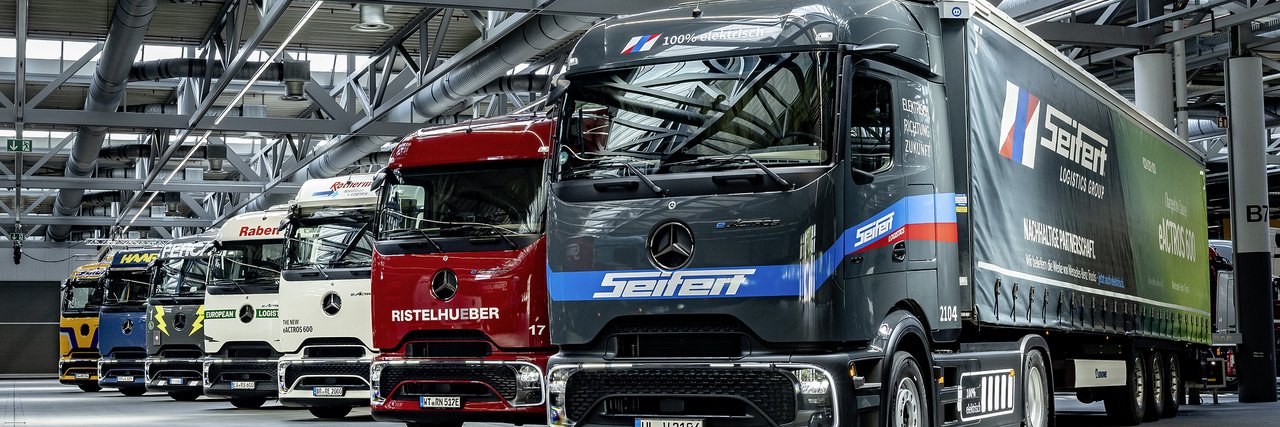
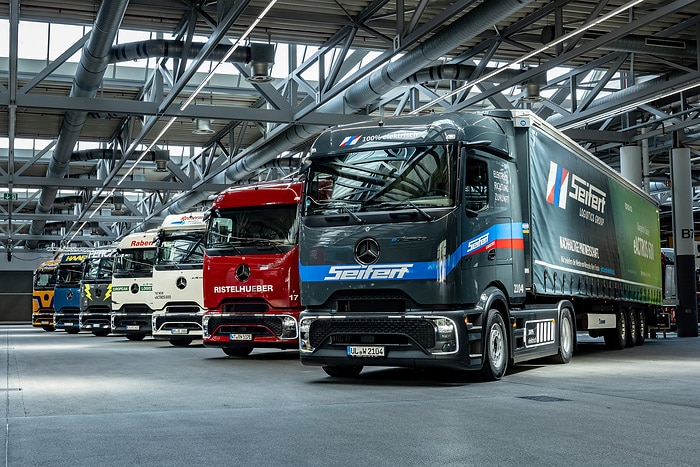
A real‑world example from the Ulm‑based logistics company Seifert illustrates a route between Wörth am Rhein and Bielefeld. An eActros 600 with an average gross combination weight of 36 metric tons achieves a daily mileage of around 600 kilometers, with approximately half of the charging events taking place at public charging points. On this route, the electric truck also achieves toll savings of more than €4,000 per month. Annually, this route saves 90 metric tons of CO2e(2). Average energy consumption between November and February is 100 kWh per 100 kilometers which is equivalent to approximately 11 liters of diesel.
The data demonstrate that demanding long‑distance routes can already be operated reliably and predictably on this route using today’s public charging infrastructure and economically as well, when TCO is considered.
More economical than diesel trucks in shuttle operations
Economic advantages are particularly evident in shuttle operations. On the route from Germersheim to Wörth am Rhein, an electric truck operated by Logistik Schmitt, based in Bietigheim in Baden, completes eight daily runs covering a total of 352 kilometers, with an average gross weight of 30 metric tons. Average energy consumption on this route is 114 kWh per 100 kilometers, equivalent to around 12 liters of diesel for a conventional truck, resulting in annual CO2e savings of 56 metric tons(2). Battery charging takes place entirely during loading and unloading times, eliminating additional downtime. Monthly toll savings exceed €2,300, and three Mercedes‑Benz eActros electric trucks have replaced the previously used diesel vehicles.
This clearly shows that under real‑world conditions, battery‑electric vehicles also offer advantages over diesel, particularly where toll costs are high and low‑cost on‑site electricity is available.
Electric trucks master challenging topography and long distances
Another route runs from South Tyrol (Italy) toward Wörth am Rhein. On this long‑haul route operated by the Bozen‑based transport company FERCAM, the eActros 600 likewise covers around 600 kilometers per day with a gross combination weight of up to 42 metric tons -despite demanding gradients and winter temperatures. During the data collection period from November to February, energy consumption on this route averages 92 kWh per 100 kilometers, equivalent to 10 liters of diesel. With recuperation of 25 kWh per 100 kilometers, the system operates with particularly high efficiency. Annual CO2e savings of 90 metric tons(2) and monthly toll advantages of €3,900 further demonstrate that electric trucks can be deployed reliably and efficiently by FERCAM in international long‑haul transport and are also economically viable in terms of TCO.
Charging infrastructure continues to expand
A comprehensive charging infrastructure is essential for the successful deployment of electric trucks. Mercedes‑Benz Trucks identifies three parallel areas of growth in charging solutions: first, plant and depot charging, where major shippers are establishing their own charging points within their logistics chains; second, semi‑public charging, in which logistics companies build partially publicly accessible charging infrastructure that can be shared with partners or used reciprocally; and third, public charging, supported by providers such as Milence - the joint venture of Daimler Truck, TRATON, and Volvo - which is advancing a network of high‑performance public charging hubs.
With the existing infrastructure, many real‑world transport applications can already be implemented reliably. However, to accelerate the transformation of road freight transport, the public charging network must be expanded significantly further.
About the eActros 600
Mercedes-Benz Trucks celebrated the start of series launch of the eActros 600 at the Mercedes-Benz Wörth am Rhein plant at the end of 2024, and the vehicle has since been in daily operation on roads in more than 15 European countries.
The electric flagship from Mercedes-Benz Trucks has already proven its capabilities several times under real-life conditions prior to the series launch: In customer use and as part of the ‘eActros 600 European Testing Tour 2024’, a 15,000-kilometer all-electric development trip through a total of 22 countries and the ‘European Testing Tour Winter 2025’ on around 6,500 kilometers through Northern Europe, each with a gross combination mass of 40 tons. In addition, the e-truck was voted ‘International Truck of the Year 2025’. The award is the most important prize in the industry and is presented annually by the International Truck of the Year (IToY) organization, consisting of 24 commercial vehicle journalists from Europe.
The high battery capacity of over 600 kilowatt hours - hence the model designation 600 – and a new, particularly efficient electric drive axle developed in-house enable the eActros 600 to achieve a range of 500 kilometers(3] without intermediate charging. This range is accomplished under very realistic and practical conditions with a gross combination mass of 40 tons, which can also be significantly exceeded depending on the driving style and the route. The eActros 600 will even be able to cover well over 1,000 kilometers per day. Intermediate charging during statutory driver breaks makes this possible, provided that charging options are available.
The eActros 600 has three battery packs, each with 207 kWh(4). These offer an installed total capacity of 621 kWh. The batteries are based on lithium iron phosphate cell technology (LFP) and are characterized by a long service life. The development engineers at Mercedes-Benz Trucks designed the eActros 600 to meet the same requirements for the durability of vehicles and components as a comparable conventional heavy-duty long-haul Actros. This means up to 1.2 million kilometers in ten years of operation. After this period of use, the battery state of health should still be above 80 percent. In contrast to other battery cell technologies, more than 95 percent of the installed capacity can also be used with LFP technology. This facilitates a higher range with the same installed battery capacity. The vehicle is technically designed for a gross combination mass of up to 44 tons. With a standard semitrailer, the eActros 600 has a payload of around 22 tons in the EU. There might be cases in which national law allows higher payloads.
In order to meet even more customer requirements, Mercedes-Benz Trucks recently expanded its battery-electric truck portfolio with additional variants based on the Mercedes-Benz eActros 600. Depending on their requirements in terms of range, payload, and comfort, customers will be able to choose between two cab variants, two or three battery packs, numerous wheelbases, and new axle configurations. The second model generation of the eActros thus offers over 40 variants of the base vehicle. The new vehicle versions feature the key characteristics of the eActros 600, such as LFP battery technology and the specially developed eAxle.
A further new variant within the eActros portfolio is the Mercedes-Benz eActros Lowliner, available with either two or three battery packs. It expands the manufacturer’s electric truck offering by adding a solution tailored for high-volume transport applications. The first new models will be available to order in the EU30 markets and additional markets from the third quarter of 2026, with series production at the Wörth am Rhein plant scheduled to start in the second quarter of 2027. The manufacturer will provide comprehensive information on this new vehicle variant at this year’s IAA Transportation in September.
Sustainability at Mercedes-Benz Trucks
Sustainability is a key element of Mercedes-Benz Trucks’ strategy. As part of Daimler Truck AG, the company aims to contribute to the decarbonization of road freight transport and the transformation of the transport industry. With battery-electric and hydrogen-based drive solutions as well as digital services, Mercedes-Benz Trucks is working to enable transport solutions with lower local CO2e emissions.
In addition, the company is implementing measures aimed at gradually improving the energy and resource efficiency of its production and supply processes. In this way, Mercedes-Benz Trucks supports the sustainability ambitions of Daimler Truck Group.
(1) Source: https://www.acea.auto/files/Press_release_commercial_vehicle_registrations_fulll_year_2025.pdf
(2) Internal calculations based on the methodologies of the Global Logistics Emission Council (GLEC)
(3) The range was determined internally under specific test conditions, after preconditioning with a 4x2 tractor unit with a 40 tons total towing weight at 20°C outside temperature in long-haul operation and may deviate from the values determined in accordance with Regulation (EU) 2017/2400.
(4) Nominal capacity of a new battery, based on internally defined boundary conditions. This may vary depending on the application and ambient conditions.
Download
Electrified inbound logistics: Real-world operational data reveal the potential of battery-electric trucks
Leinfelden‑Echterdingen – The decarbonization of transport is gaining further momentum in Europe. In 2025, around 5,000 new battery‑electric trucks over 16 metric tons were registered in the EU(1), representing growth of approximately 51 percent year over year. Nevertheless, market share remains at only about two percent—highlighting both the significant need for action and the substantial potential of CO2e‑free commercial…
Article assets
Download
Electrified plant logistics in Wörth: 14 eActros 600 launching on long-haul routes

Download
Electrified inbound logistics: Real-world operational data reveal the potential of battery-electric trucks
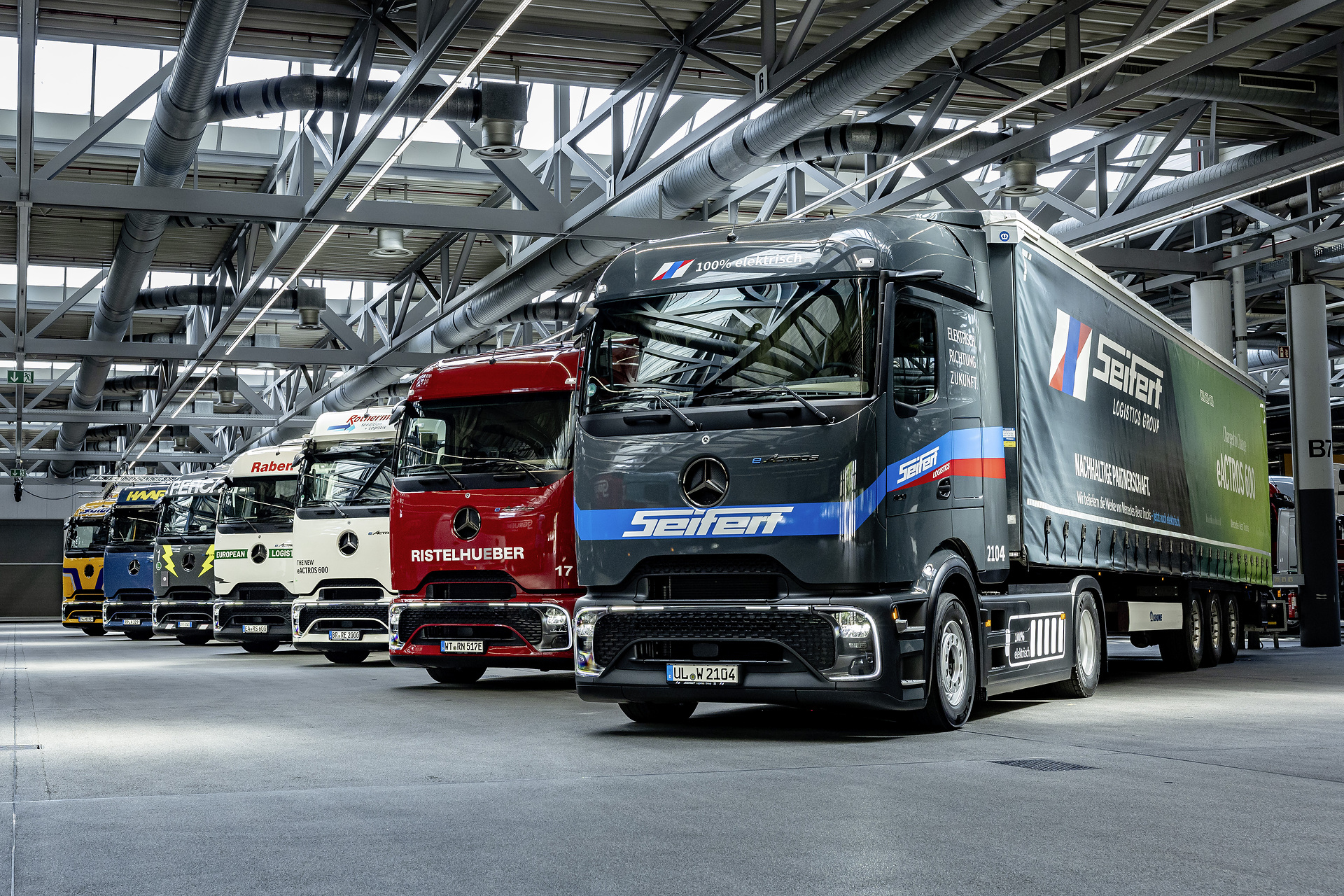
Electrified plant logistics in Wörth: 14 eActros 600 launching on long-haul routes
Electrified inbound logistics: Real-world operational data reveal the potential of battery-electric trucks

Ulrike Burkhart
Spokesperson Truck Product & Defence
ulrike.burkhart@daimlertruck.com
+49 160 861 3757

Katrin Fischer
Spokesperson Truck Product
katrin.fischer@daimlertruck.com
+49 176 30966698